
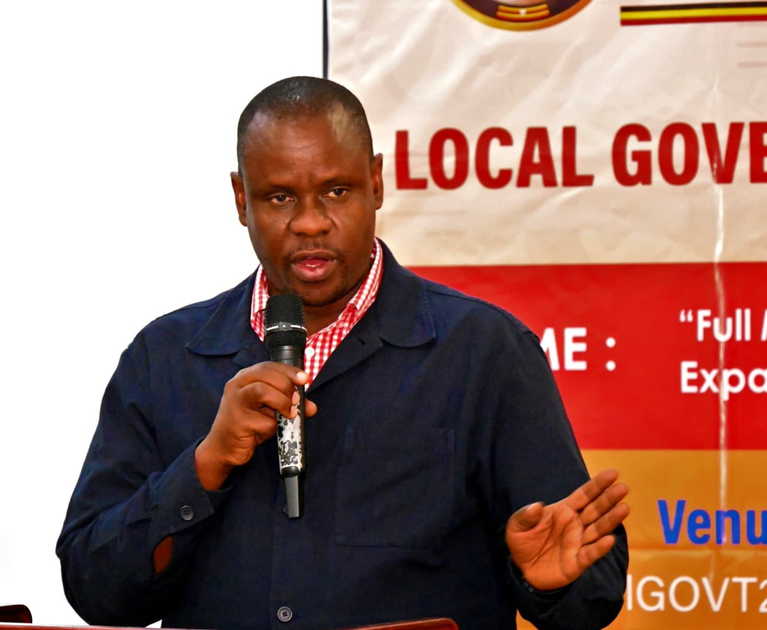
Mbale – The Minister of Local Government, Hon. Barugahara Balaam Ateenyi, has called for a more responsive and people-centred approach to planning and budgeting for local governments, urging stakeholders to ensure that the Financial Year 2027/28 budget addresses the actual challenges affecting communities across the country.
Hon. Balaam made the call while addressing stakeholders participating in the Financial Year 2027/28 Local Government Budget Consultative Workshops, bringing together district chairpersons, Resident District Commissioners, Chief Administrative Officers, town clerks, mayors, local government councillors, heads of departments and other local government leaders.
The Minister commended the participants for making time to take part in the consultations, noting that their participation demonstrates a collective commitment to improving planning, budgeting and service delivery across districts, cities and municipalities.
He emphasised that local government budgeting should ultimately be about the services and opportunities that reach people at community level, stressing the need for the Financial Year 2027/28 budget to respond to the realities faced by citizens and the officials responsible for delivering services.
Hon. Balaam identified a number of persistent challenges that require attention as Government prepares the Financial Year 2027/28 budget.
Among the concerns highlighted is the shortage of qualified science teachers in government schools.
According to the Minister, inadequate numbers of science teachers continue to affect the quality of science education and limit the country’s ability to prepare young people for a modern, industrial and technology-driven economy.
He called for a review of staffing levels, recruitment, deployment and retention of science teachers, particularly in underserved areas.
The Minister also highlighted inadequate road equipment as a major challenge affecting many districts.
He noted that local governments often depend on a limited number of graders, excavators, tipper trucks and other machinery, making it difficult to respond effectively to road maintenance requirements.
Hon. Balaam called for sustainable approaches to increasing the availability and utilisation of road equipment so that districts can maintain their road networks more effectively while reducing the cost of relying on external contractors for routine works.
Another challenge highlighted was inadequate resources for service delivery. The Minister noted that local governments continue to face pressure to deliver more services with limited resources, and called for available funds to be directed towards interventions that have the greatest impact on communities.
He further identified staffing gaps within some local governments, observing that inadequate staffing affects implementation, supervision and accountability. He stressed that recruitment and deployment should be aligned with actual service-delivery needs.
Hon. Balaam also underscored the importance of maintaining existing public infrastructure.
He noted that as Government continues investing in schools, health centres, roads, markets and other infrastructure, adequate resources must also be provided for their maintenance.
According to the Minister, constructing infrastructure without sufficient resources for maintenance undermines the value and sustainability of such investments.
He therefore called for maintenance to remain an important consideration in local government planning and budgeting.
The Minister described the budget consultations as an important opportunity for local governments to identify their most urgent needs and ensure that these are reflected in national planning and resource allocation.
He outlined several areas that the consultations should address, including listening to the experiences and priorities of district leaders and technical officers, identifying funding and staffing gaps, aligning local government plans with national development priorities, and strengthening accountability and value for money.
He also called for budgets to be based on evidence and actual community needs, while encouraging stakeholders to agree on practical solutions that can be implemented during the Financial Year 2027/28.
Hon. Balaam cautioned that the discussions and issues raised during the consultations should not remain on paper.
He called on leaders and technical officers to ensure that the outcomes of the consultations inform planning, resource allocation and implementation.
He further emphasised the importance of strengthening monitoring at local government level so that every shilling allocated produces a visible service or development outcome for the people.
“The Financial Year 2027/28 budget should therefore be a people-centred budget—one that addresses the realities on the ground, strengthens local governments and improves service delivery.”
The Minister thanked the Minister of Finance in charge of Planning and Economic Development, district leaders, political leaders, technical officers and other stakeholders for their participation and commitment to serving the people.
He urged participants to use the consultations honestly and constructively to identify challenges, agree on priorities and develop practical solutions for better service delivery.
The consultations therefore provide an important platform for local governments to articulate their priorities and contribute to shaping a Financial Year 2027/28 budget that responds to the needs of communities while strengthening service delivery, accountability and the effective use of public resources.